
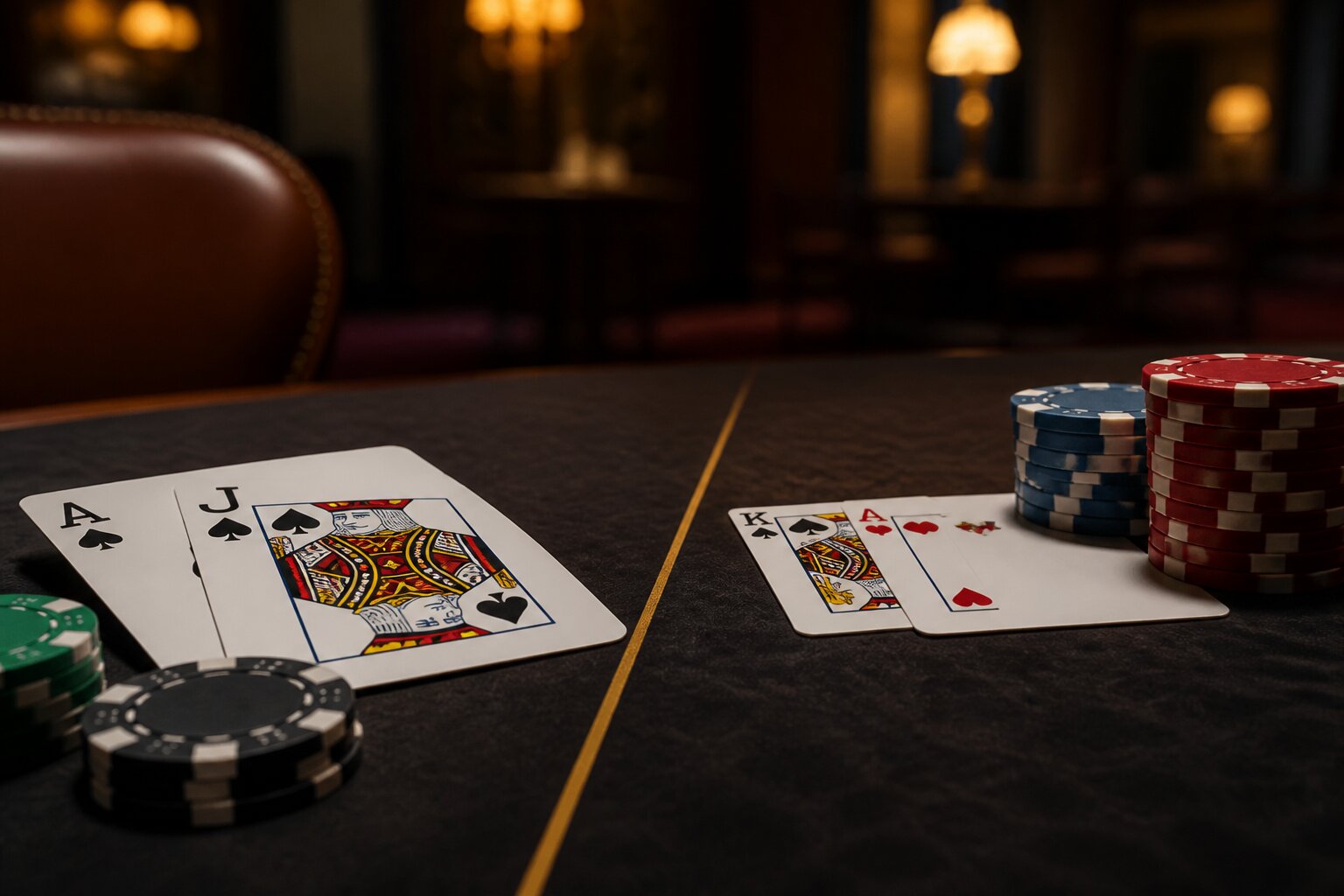
Ever wondered which game is more rewarding—Blackjack or Poker? You're not alone. Many players wrestle with the same question when choosing between the quick rounds of Blackjack and the strategic depth of Poker.
Both games reward different skills and offer different payout patterns. Understanding how each one pays out and what influences winnings helps you make a clearer choice about where to spend your time and money. Read on to see which game might suit your goals at the table.
Understanding the Basics of Blackjack and Poker
Blackjack and Poker are both card games but they unfold very differently. In Blackjack the objective is to build a hand close to 21 without going over, and each player competes directly against the dealer rather than other players. Cards have set values, aces can count as 1 or 11, and options such as hit, stand, double down or split shape the round. The gameplay is brisk, with each hand resolving in a short time.
Poker comes in many forms; Texas Hold’em is the most familiar. Players construct the strongest five-card hand from private and shared cards, using betting rounds and table dynamics to extract value or force folds. Unlike Blackjack, Poker is a contest among players where reading opponents and managing bets matter as much as the cards themselves.
With those differences in mind, the next section takes a closer look at how Blackjack pays out so you can see how those quick rounds translate into returns.
How Do Payouts Work in Blackjack?
Blackjack payouts are generally straightforward. When a player beats the dealer without busting, the usual return is even money: a £10 wager generates a £20 return including the original stake. A natural Blackjack—an ace plus a ten-value card—typically pays at 3:2, so a £10 bet would return £25.
If your hand ties the dealer’s, the round is a push and your stake is returned without profit. Side bets and insurance options exist at many tables; these involve separate odds and, in most cases, a higher house advantage. Rule variations such as dealer hitting on soft 17, number of decks used and allowed player options change the house edge, so it’s worth checking table rules before you sit down.
Understanding these payout mechanics clarifies why Blackjack tends to produce smaller, more frequent outcomes compared with Poker’s varied pots. Next, we’ll examine how winnings are generated in Poker and why they can look very different.
How Do Winnings Differ in Poker?
Poker winnings come from the pot—money contributed by players during the hand. The size of each pot depends on how much players bet, so outcomes can range from modest returns in quiet hands to large payouts in high-action pots or big-field tournaments.
Cash games let you exchange chips for real money directly and winnings are won hand by hand. Tournaments work differently: everyone buys in for a fixed amount and prize money is distributed to the top finishers according to a payout structure, often heavily weighted towards the later positions. Here, deep runs can produce outsized returns compared with individual cash-game pots.
Success in Poker stems from combining hand strength with strategic betting, positional awareness and opponent reading. Those elements determine how often you claim sizeable pots. With that in mind, the following section compares the statistical measures that describe each game’s long‑term returns.
Comparing Typical House Edge and RTP
House edge and RTP are ways to quantify expected returns, but they apply differently across Blackjack and Poker. Blackjack has an explicit house edge that reflects the casino’s advantage under a given rule set; with basic strategy and favourable rules this can sit around 0.5% to 1%, corresponding to an RTP close to 99% over very large samples of play. Changes to rules—fewer splits, different dealer behaviour, or more decks—raise the edge and lower the RTP.
Poker does not have an RTP in the same sense because players compete against one another. Instead, operators take a rake from each pot or charge tournament fees, typically around 2% to 5%. Your effective return therefore depends on your skill relative to opponents and how much rake or fees you pay. In other words, statistical averages are meaningful for Blackjack as a house-controlled game, whereas Poker’s returns are driven by player performance after accounting for the operator’s cut.
Those distinctions guide how payouts typically behave in each game. The next section looks at factors beyond the basic math that can influence outcomes at the tables.
What Influences Payouts in Each Game?
Payouts are shaped by rules, betting structures and player choices. In Blackjack, table rules and the number of decks determine the built-in advantage; player decisions—when to hit, double or split—influence short-term results. Mastering basic strategy reduces expected losses but does not eliminate the house advantage where one exists.
In Poker, the key drivers are skill, table dynamics and pot sizes. The mix of players at your table, the level of aggression in the room and how well you manage your stack across hands affect how often you win pots and how large those pots become. Tournament formats add further variables: payout structures, blind schedules and payout bubbles can all change incentives and outcomes.
Because these influences differ, potential winnings look different too—Blackjack offers more predictable, rule-based returns while Poker offers variable returns tied to player performance. To see where extra payoff opportunities arise, the following section examines jackpots and bonuses.
Jackpots and Bonus Opportunities Compared
Both games offer occasional bonus features, but they appear in different forms. Blackjack sometimes has optional side bets or progressive features that require extra stake and offer larger but rare payouts for specific combinations. Online platforms may also promote time-limited offers linked to Blackjack play, usually with terms attached.
Poker presents bonus and jackpot opportunities mainly through tournament prize pools, progressive bounties, and site promotions that reward play over time. Large tournaments can deliver substantial payouts for top finishers, while special jackpot formats or bounty events create extra earning possibilities for achieving particular results.
Whether you chase these extras or focus on base-game play, it’s important to understand the conditions that govern bonus eligibility and payouts. With that context, the next section dispels common misunderstandings about how payouts work.
Myths About Casino Payouts in Blackjack and Poker
Several persistent myths cloud how payouts operate. One is the idea of streaks altering future outcomes; in regulated games, each hand or deal is an independent event subject to the same rules and randomisation methods. Another is the belief that “systems” can guarantee profit; while strategy improves expected returns, there’s no method that eliminates the house advantage or ensures consistent winnings in Poker without superior skill versus opponents.
Concerns about online platforms manipulating odds or withholding payouts are addressed by regulation and testing in licensed markets; independent audits and certification of random number generation and game fairness are routine requirements. Finally, larger stakes do not change the underlying odds; they only magnify the scale of wins and losses based on the same rules.
Clearing up these misconceptions helps set realistic expectations for both games. With a truer sense of how payouts behave, you can choose the game that best matches your objectives and temperament.
Choosing the Right Game for Higher Winnings
Picking between Blackjack and Poker hinges on your goals and strengths. If you prefer clearly defined odds and shorter rounds, Blackjack offers consistent, modest payouts that reward correct play under fixed rules. If you favour strategic depth, multi-layered decision-making, and the prospect of larger but less predictable returns, Poker provides that opportunity—especially for players who can exploit weaker opponents or perform strongly in tournaments.
Consider also the time you want to commit: Poker often rewards longer-term investment in skill and table selection, while Blackjack requires discipline and familiarity with strategy charts. Whatever the choice, select stakes that align with your budget and play style to keep the experience sustainable. Having set that foundation, the final section summarises the practical differences to help you decide.
Conclusion: Blackjack or Poker for Better Payouts?
Blackjack and Poker offer distinct paths to winning. Blackjack delivers structured odds and relatively low house advantage when played optimally, producing steadier, smaller-scale returns. Poker can produce larger payouts, particularly in tournaments or against weaker opposition, but outcomes vary more and depend on skill and competitive conditions after accounting for rake or fees.
Choose Blackjack for predictable play and clear, rule-based returns; choose Poker if you seek strategic depth and the potential for bigger, less frequent wins. Above all, treat either game as entertainment: set limits, manage stakes sensibly and use available controls to keep play within comfortable boundaries. With the right approach, both games can be engaging ways to spend time at the table.
**The information provided in this blog is intended for educational purposes and should not be construed as betting advice or a guarantee of success. Always gamble responsibly.