
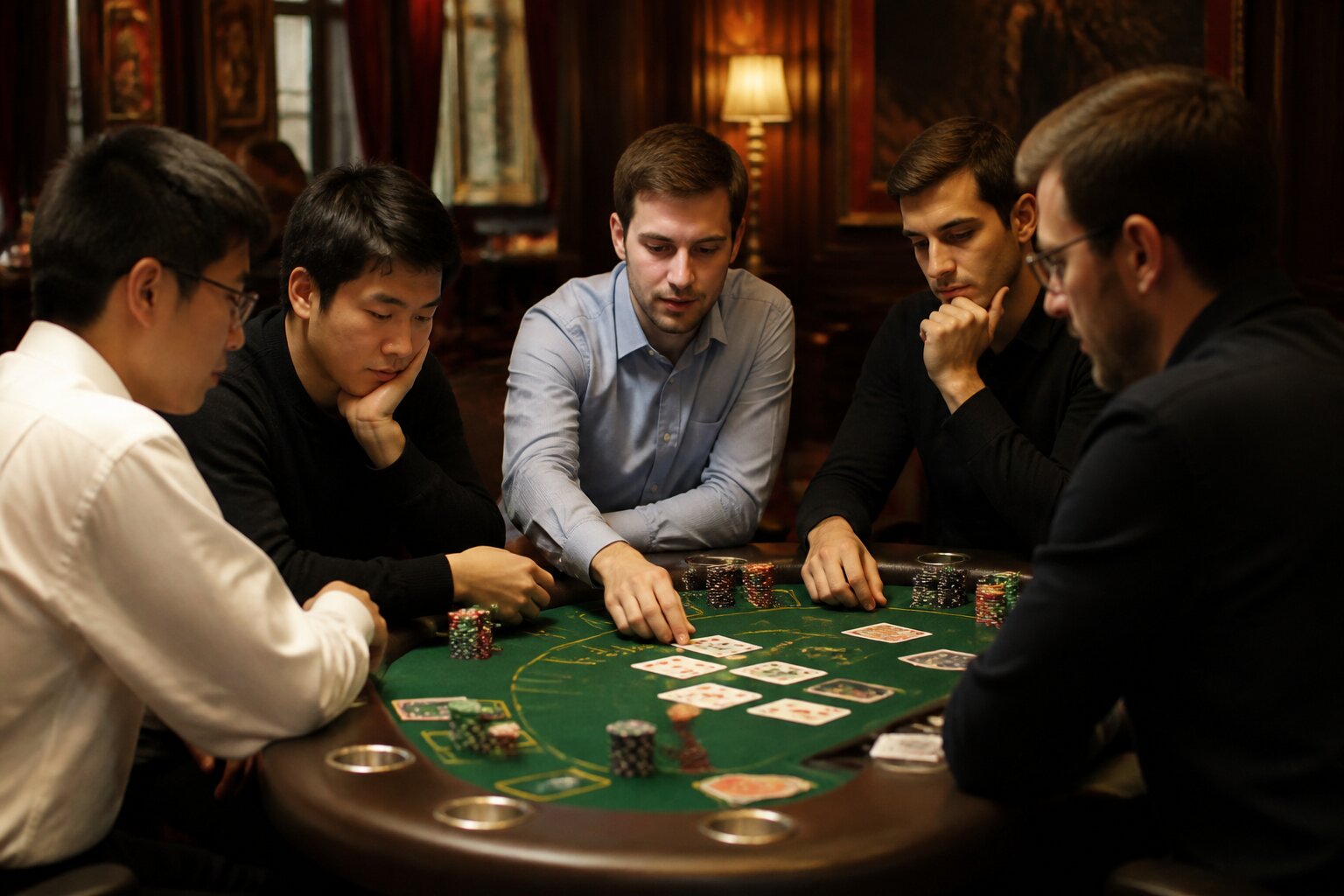
Imagine a group of students who turned mathematics into millions, beating casinos through skill, planning and teamwork. The story of the MIT Blackjack Team is not about chance; it’s about careful analysis, disciplined practice and a business-like approach to a casino game.
Their journey moved from secret training rooms to high-stakes tables in Las Vegas and beyond. Along the way they developed systems, assigned roles and learned how to scale an operation — lessons that read like a case study in organisation as much as a gambling tale.
Read on to meet the people involved, learn how their methods worked in practice, and see what ultimately happened to the team and their earnings.
The MIT Blackjack Team was made up of students and graduates from the Massachusetts Institute of Technology and other nearby universities. They pooled mathematical skill, patience and a strict structure to gain small, repeatable advantages at blackjack. Members trained together, reviewed results and refined techniques so the group performed like a professional operation.
Roles were allocated to match temperament and ability: some focused on observing the table quietly, others came in to place larger bets when conditions were favourable. That division of labour, together with detailed record-keeping and rotation of personnel, kept the team coordinated and reduced the chance of exposure.
Notable Individuals and Their Roles
Bill Kaplan
Bill Kaplan acted as a central organiser who treated the group like a business. He established training routines, managed funds and helped recruit people with the right mix of skills and temperament. Kaplan emphasised structure and accountability, putting systems in place to track performance and enforce consistency.
His approach made it easier for the operation to scale, by standardising practices and ensuring new members learned the same methods. That organisational focus also helped maintain discipline and clarity about roles within the group.
John Chang
John Chang combined front-line play with managerial duties. He was active in coaching recruits and handling financial matters, ensuring that betting rules and money management protocols were followed. Chang’s dual role meant he could both demonstrate techniques at the table and supervise their correct application off it.
This combination of practical and administrative work helped keep the team disciplined during intense sessions. His attention to detail around record keeping and bankroll controls supported longer-term stability for the group.
J.P. Massar (known as “Mr M”)
J.P. Massar co-founded the original group and contributed to strategy development and oversight. He worked on designing training exercises and monitoring performance across teams, helping to translate theory into reliable table behaviour.
Massar’s role was less about day-to-day play and more about ensuring methods were robust and reproducible. By focusing on systems and measurement, he helped the group refine techniques and maintain consistent standards.
Laurie Tsao
Laurie Tsao was one of the more prominent female players, known for composure at the table and attention to detail. Her presence demonstrated the team’s ability to recruit members who combined analytical skill with the nerve required for high-pressure play.
Tsao’s approach emphasised careful observation and disciplined execution, traits that set a strong example for newer recruits. Her performances contributed to the team’s reputation for professionalism.
Semyon Dukach
Semyon Dukach later took on leadership tasks, organising teams and helping guide successors. He played a part in transferring knowledge and establishing processes for training and team management.
Dukach’s later career outside the team shows how experience in organising, coaching and decision making can be applied in other fields. His trajectory highlights the practical skills developed during his time with the group.
The roster included many other members whose contributions ranged from counting and signalling to logistics and bookkeeping. Together they formed a networked operation rather than a loose group of enthusiasts.
- Counting and signalling
- Logistics and travel coordination
- Bookkeeping and financial controls
- Training and performance monitoring
How Did the MIT Blackjack Team Operate?
Their method relied on statistical assessment and coordinated behaviour. Card counting was central: players tracked which cards had been dealt to estimate whether the remaining deck favoured the player or the dealer. This information then informed betting decisions.
Rather than each player acting independently, the team used a layered system. Spotters sat at tables placing small bets while signalling favourable counts to a “big player” who would enter and place larger stakes when the odds tilted. That separation kept large bets from drawing attention to one person and allowed the team to exploit short windows of advantage.
Practice was rigorous. Members rehearsed counting under conditions that simulated casino pressure and worked on signalling methods that were both subtle and reliable. Sessions were recorded and analysed so mistakes could be corrected and models updated.
Operational discipline extended to money handling and rotation. The team pooled capital, divvied up profits according to agreed shares, and moved players between venues to reduce pattern detection. That commercial mindset — treating play as a repeatable, measurable enterprise — made their approach more resilient than ad hoc gambling.
Security responses from casinos evolved over time, and by the 1990s many venues had improved surveillance and countermeasures. These changes, together with internal costs and the difficulty of staying undetected indefinitely, influenced how the operation changed and eventually wound down.
Now that you understand how they organised themselves, it helps to see how that story ended and what it meant for the people involved.
What Happened to the MIT Blackjack Team in the End?
As the team’s successes became known, casinos adapted. Surveillance improved, staff learned to recognise coordinated play, and players who aroused suspicion were watched closely or refused entry. Face recognition, database sharing and stricter identification policies made it harder to operate openly.
Faced with increased risk and diminishing returns, the group gradually disbanded in the late 1990s. Members pursued other careers where their analytical abilities and teamwork were valuable. For many, the blackjack years became a formative experience rather than a lifelong occupation.
The environment in regulated markets now includes robust safeguards to ensure games are conducted fairly and within the law. That regulatory framework, alongside technological countermeasures, means the conditions that once allowed a coordinated team to profit have largely disappeared.
How Much Did the MIT Blackjack Team Actually Earn?
Estimating the team’s total earnings is difficult because play stretched over years, involved many participants and profits were shared and reinvested. Contemporary sources and interviews suggest cumulative winnings in the low millions of dollars, with commonly cited figures around $5 million (approximately £4 million at the time). These numbers reflect gross takings rather than net personal wealth.
Individual outcomes varied widely. Some core members earned substantial sums during their tenure, while others received more modest returns after deducting travel, living costs and contributions to the team’s bankroll. Payments were typically split according to pre-agreed formulas that recognised roles and capital invested.
It’s also important to note that those earnings were produced in a specific historical context: looser casino countermeasures, different shuffling and dealing practices, and an ability to move players between venues. Those conditions do not apply in modern, tightly regulated markets where games are monitored and safeguards are in place to protect both players and operators.
Knowing the financial picture helps explain why the team attracted attention and why casinos responded as they did.
Where Are Former MIT Blackjack Team Members Now?
After the operation ended, most members moved on to conventional careers. The analytical and organisational skills they developed proved transferrable.
Bill Kaplan pursued investment and property activities. John Chang applied his management experience to business ventures. Semyon Dukach moved into technology and entrepreneurship, working with start-ups and mentoring founders. Some former members published accounts, gave talks or took part in documentaries that examined the team’s methods and culture.
Many others chose privacy and left public life. The common thread is that the team’s period of play was a chapter, not a lifetime pursuit, and most members built durable careers outside the casino world.
If you’re curious about the boundaries between skill-based work and gambling, the team’s post-play careers offer a clear example of how specialised experience can lead to diverse opportunities.
Did the MIT Blackjack Team Really Break the Bank?
The team did not bankrupt casinos. Large casinos absorb wins and losses as part of normal business, and they quickly introduced procedural and technical safeguards once the team’s methods became visible. Although the team won significant sums relative to individual players, those amounts represented a small fraction of a casino’s overall income.
What the team did achieve was an unusual and well-documented streak of profitable sessions that exposed vulnerabilities in casino practice at the time. In response, venues adjusted rules, shuffling methods and surveillance tactics, closing the window of opportunity.
Understanding the scale of their earnings versus the size of casino operations helps separate dramatic storytelling from practical reality.
The final point to remember: extraordinary stories are best read with a critical eye.
Myth 1: They Always Won
The team did not experience unbroken success. Losses and setbacks occurred, and sometimes they stopped play to limit further losses. Their results were driven by probability management and disciplined decision-making rather than any guaranteed outcome.
Myth 2: The Team Made Members Rich for Life
While several members did well financially during their involvement, payouts were shared and often offset by expenses. Many members went on to normal careers and did not live solely off casino profits.
Myth 3: Anyone Can Replicate Their Success
Replicating the team’s achievements would have required exceptional skill, lengthy practice, strict organisation and the specific casino conditions of that era. Modern, regulated environments and advanced security measures mean those conditions are no longer present.
The MIT Blackjack Team remains a notable example of applied mathematics and teamwork in an unusual setting. Their story highlights how specialised skills can produce short-term gains, but it also shows how systems adapt and close loopholes over time.
**The information provided in this blog is intended for educational purposes and should not be construed as betting advice or a guarantee of success. Always gamble responsibly.