
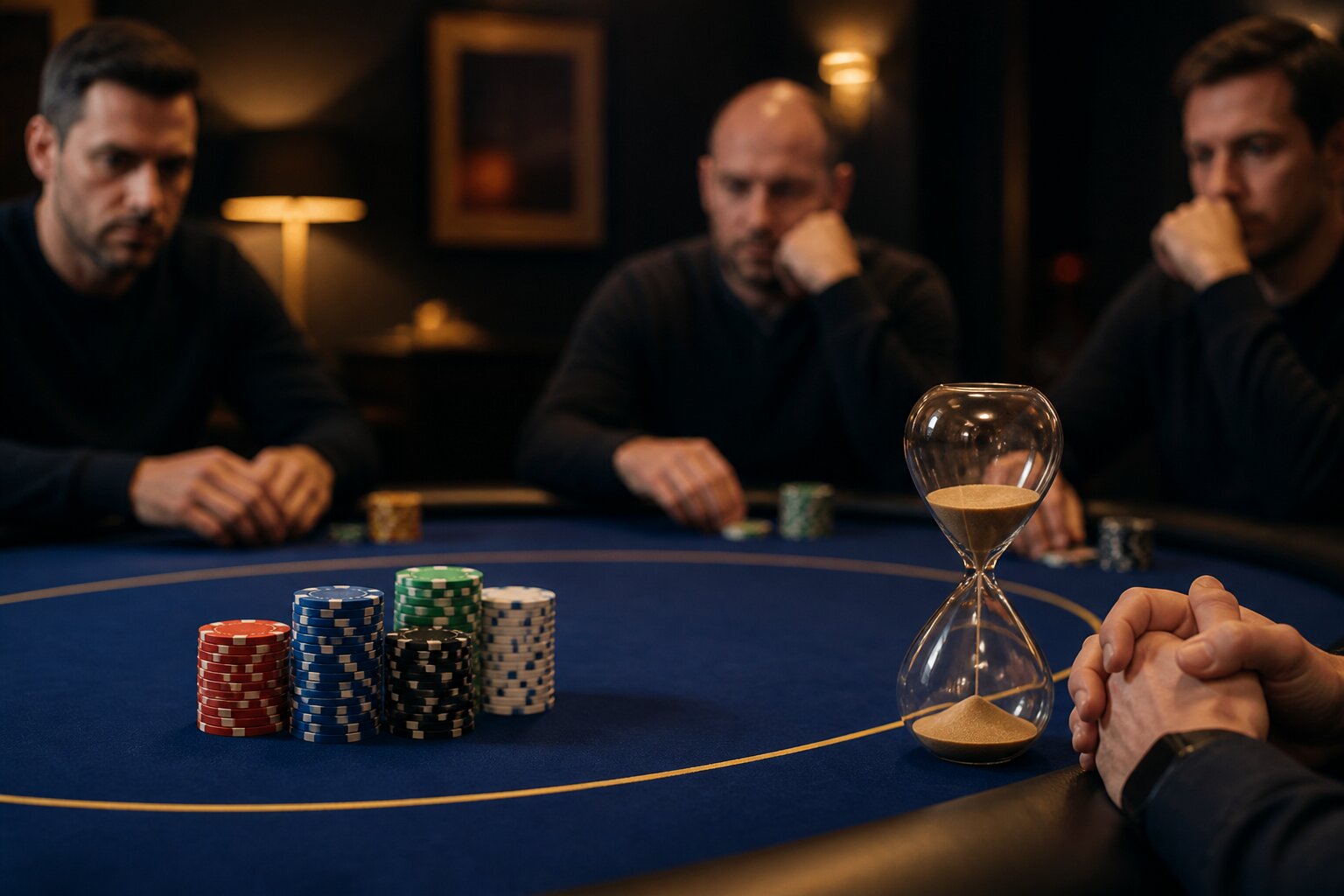
Ever settled down for a friendly game of poker, only to wonder if you’ll be there all night? You’re not alone—one of the first questions many players ask, whether online or in a casino, is “How long will this take?” Maybe you’ve squeezed in a quick session before dinner or cleared your diary for hours, only to finish much sooner than expected.
The answer isn’t quite as straightforward as shuffling and dealing the cards. The pace of play, the number of players, and the simple choice between cash games and tournaments all influence how long you’ll be at the table. Knowing what to expect helps you plan your time and set sensible limits before you sit down.
Read on to discover typical lengths for different formats and the features that make one game fly by while another drags on.
How Long Does a Cash Game Usually Last?
Cash games are flexible by design. There’s no fixed start or finish: players may join or leave according to the house rules, and each session’s length usually comes down to personal preference and circumstances at the table.
For many casual players, a typical session might run between one and two hours, a tidy slot for an evening or a break. Some players choose longer sittings, especially at higher-stakes tables, where sessions of four hours or more are common. In busier bricks-and-mortar rooms, regulars will sometimes stay for an entire evening.
Online play offers similar variety: you can pop in for thirty minutes or settle in for longer, and formats like fast-fold games make for especially rapid hands. Table size, stakes and the mix of players all influence this, which leads naturally into the specific factors that shape game length.
What Factors Influence Poker Game Duration?
A number of elements combine to determine how quickly a poker session moves. Understanding them helps set realistic expectations and plan the kind of session you want. Different mixes of these elements can produce very different experiences, from a short, intense burst of hands to a long, strategic grind.
Number of Players at the Table
A full table (usually nine or ten players) means more hands between your turns and generally longer pots and decision times. With more players, there are more betting rounds and more opportunities for action, which naturally lengthens each orbit and the overall session.
Short-handed tables—six players or fewer—create more frequent action and higher hand turnover, shortening the overall session length. The dynamics also change: you will act more often and need to widen your range, which tends to speed up play and increase the number of hands dealt per hour.
Table Stakes and Blind Levels
Lower-stakes tables often encourage patient, value-focused play that can stretch a session. Players at these stakes may be more willing to wait for strong hands and to engage in longer, post-flop battles, which can make each hand take considerably more time.
Higher blinds accelerate betting and can lead to faster resolution of pots, shortening the time you will spend at the table. In addition, fast-fold or turbo cash formats online are designed to compress play into a much tighter timeframe, moving players away from a single table and into quick, repeatable decisions.
Player Experience and Playing Style
Experienced players tend to act with more speed and purpose, while newcomers may take longer when making decisions. Skill level affects not only the time taken per decision but also the frequency of complex situations like big bluffs or multi-way pots, both of which influence how long hands last.
Aggressive styles generally push hands to an earlier conclusion; conservative play stretches them out. The overall tempo of a table is a product of these styles and the personalities present. Social factors, such as table talk and breaks, can also slow the game, whereas a focused, competitive table will usually move faster.
Those factors directly shape the contrast with tournaments, where structure and elimination create a different rhythm. Tournament play has clocked levels and rising blinds that systematically change decision-making and session length in ways distinct from cash games.
How Do Tournament Timings Compare to Cash Games?
Tournaments run on a fixed schedule with rising blinds and a commitment to stay in play until you’re eliminated or choose to leave. They start at a set time and follow a structure which, when published in advance, helps players plan for the likely duration.
Shorter online events often last two to five hours, while larger live tournaments can extend across an evening and sometimes into the early hours. Major events may span multiple days. Because blinds increase at regular intervals—commonly every 15, 20, 30 or 60 minutes—play tends to accelerate as the field narrows and stack sizes change. If you’re aiming for later stages, it’s wise to allow extra time for deep runs.
Next, a quick look at typical durations for popular tournament formats will give a clearer picture of what to expect.
Average Length of Popular Poker Tournament Formats
Below are common tournament types and the usual timeframes associated with each.
- Sit & Go (SNG): Single-table events that typically last 45 to 90 minutes. They start once the table is full, making them a compact option for players short on time.
- Standard Multi-Table Tournament (MTT): Larger fields can stretch these to 4–8 hours or more, depending on entrants and the blind structure.
- Turbo Tournament: Faster blind increases (often every 5 minutes) shorten play, commonly producing a 90-minute to 2-hour event.
- Bounty Tournament: Similar to standard MTTs but with elimination prizes; sessions usually run 3–6 hours.
- Satellite Tournament: These feed into bigger events and vary in length, though many complete within 1–3 hours.
These ranges are averages; turnout, blind schedule and player behaviour will affect the final duration. If you plan to aim for late stages, build in a margin for overruns.
Can You Leave a Poker Game at Any Time?
Cash games offer freedom to leave whenever you wish: after the hand in play concludes, chips can be cashed out and you can walk away. That flexibility is a major reason many players prefer cash sessions.
Tournaments operate under a different logic. You can step away from the table, but your stack remains live and will be reduced by the blinds while you’re absent. If you leave permanently, the chips will be blinded away until you’re eliminated; re-entering at your previous stack size isn’t an option. Because of this, tournament play requires a greater upfront time commitment if you want a genuine shot at the deep stages.
With that difference in mind, it helps to think about practical ways to manage your time so your session fits into your plans and obligations.
Tips for Managing Your Time During a Poker Session
Practical habits make it easier to keep sessions within intended limits and maintain clear thinking at the table.
- Set a clear time limit before you start, and choose a session length that suits your schedule.
- Use a timer or alarm to remind yourself when it’s time for a break or to finish.
- Take short pauses every hour or so to refresh—stand up, stretch, or make a drink to reset your focus.
- Keep simple records of when you begin and end sessions to spot patterns in play and avoid unplanned overrun.
- Honour your own cut-off point; if you’re tired or distracted, finishing the session protects both judgement and enjoyment.
- Fit poker around other commitments so it remains a recreational activity rather than an intrusion.
These approaches support safer, more enjoyable play and make it easier to plan whether you’re joining a cash game or entering a tournament.
Whether you’re dropping in for a quick cash session or committing to a long tournament, game format, table dynamics and blind structure are the main determinants of how long you’ll be at the table. A little planning and some simple time-management habits let you fit poker around your life, so the game stays enjoyable and under control. If you’re ready to choose a format that fits your schedule, check the session times and structures available and pick one that suits your plans.
Play Casino Games at Pay By Mobile Casino
We invite you to enjoy a friendly and welcoming experience with us, where you can take your time and play whenever it suits you. Everyone is welcome, whether you are exploring something new or simply looking for some entertainment at your own pace.
Getting started is straightforward: just create an account, make a deposit and you are ready to begin playing. We look forward to having you with us whenever you choose to join.
**The information provided in this blog is intended for educational purposes and should not be construed as betting advice or a guarantee of success. Always gamble responsibly.