
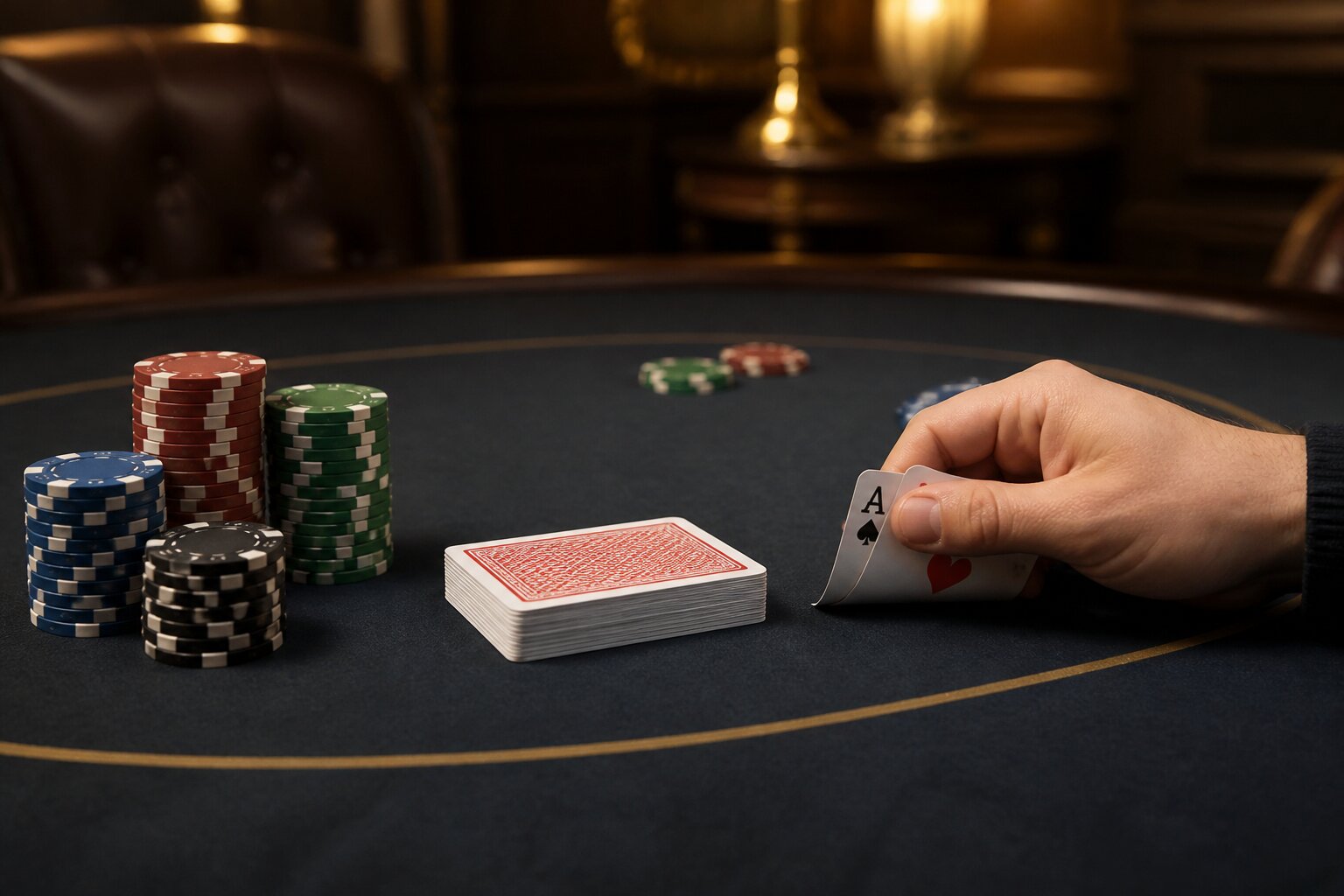
Anyone who’s watched a tense moment at a casino poker table or played a friendly hand at home has probably wondered: how many decks are actually used in poker? The cards move quickly, shuffled and dealt with practiced skill, while players watch every change. For newcomers, the number of decks can seem like a small detail, but it affects how the game is played and understood.
In most card rooms and organised games you’ll see a consistent approach to the deck: a single, standard pack is the norm across familiar poker variants. That consistency keeps the maths and strategy straightforward for players and organisers alike.
Whether you’re learning the game for the first time or sharpening your skills with mates, understanding the standard deck clears up one of poker’s basic rules and prepares you for the subtleties that follow.
What Type of Deck Is Standard in Poker?
Traditional poker uses a single 52-card pack, commonly called a French deck. It contains four suits — hearts, diamonds, clubs and spades — with 13 ranks in each suit, from two up to ace. Classic poker variants such as Texas Hold’em, Omaha and Five Card Draw are played with this standard set: no jokers, no extra cards.
Decks are shuffled between hands so every deal starts from the same baseline. In regulated venues and most organised home games, the familiar 52-card composition is the expected starting point for play. This standard keeps probabilities consistent across rounds and makes hand-reading and strategy meaningful.
Look next at how that single deck is applied across different poker variants and why the one-deck rule is so widely followed.
Poker Variants & the Number of Decks Used
Most poker formats use just one 52-card deck. That applies to cash games, tournaments and casual home play for mainstream variants such as Texas Hold’em, Omaha and Seven-Card Stud. Using one deck ensures that the possible combinations and odds remain stable, which is important for fair competition and for players thinking strategically.
Different variants change how many cards each player receives or how many community cards are dealt, but they do not change the underlying deck. For example, Texas Hold’em deals two private cards per player with community cards on the table; Omaha gives four private cards; Seven-Card Stud involves a mix of face-up and face-down cards — yet all of these draw from the same single pack. That single source of cards keeps the game’s structure intact.
Some private or informal games may alter the deck or add house rules, but these are exceptions kept to social settings rather than formal play. In the next section, we’ll consider whether multiple decks or extra cards ever appear in regulated or professional environments.
Do All Poker Games Use a Single Deck?
Practically every standard poker game uses only one 52-card deck. That is true regardless of table size or format: heads-up play, nine-handed cash tables or large tournaments all rely on the same single pack for each deal. This uniformity simplifies rule enforcement and scoring.
Private games may experiment, but recognised and regulated events do not change the single-deck setup. The predictability this creates is an important part of what makes poker a competitive skill game rather than a collection of ad hoc variants.
Are Extra Decks Ever Needed in Poker?
In standard play, extra decks are not used within a single hand. You might see an additional pack nearby in a casino or club simply to allow a quick swap after a hand or to feed an automatic shuffling machine, but only one deck is active for the deal.
Home games sometimes introduce jokers as wild cards or combine two decks for novelty formats, but those choices alter probabilities and typically make strategy and hand evaluation less standardised. Such variations are fine for social play, yet they’re not part of official or tournament rules. Moving on, the next part breaks down exactly which cards make up the standard pack everyone uses.
How Many Cards Are In a Poker Deck?
A standard poker deck contains 52 cards. Those 52 are organised into four suits, each with thirteen ranks. This structure is the same whether playing in a club, at home, or online, and it provides a consistent framework for play across different settings.
The deck does not include jokers in most traditional poker games. Jokers are sometimes used as wild cards in specific home or novelty games, but they are not part of the standard 52-card setup that underpins most formal poker rules.
Suits
Hearts
Diamonds
Clubs
Spades
Ranks in Each Suit
These suits and ranks are the building blocks of every traditional poker hand. With this deck composition fixed, players can evaluate hand strength, calculate probabilities and apply strategy in a consistent way. The standard 52-card deck also makes it straightforward to compare hands and resolve disputes, since the same set of cards and rank order applies everywhere.
Next, we’ll explore why that single-deck setup has become the established norm in poker.
Why Do Most Poker Games Use One Deck?
Keeping to one deck preserves fairness and clarity. With only one of each card in play, the possible combinations in any hand are well-defined; that makes odds calculation and strategic choices meaningful for all players. If duplicates were introduced, the value of information from seen cards — such as those revealed on the table — would be reduced, and interpreting opponents’ holdings would become less reliable.
A single deck also aids oversight and integrity. Organisers and dealers can monitor play and detect anomalies more easily when there’s a standard deck size and composition. For venues that regulate play, this makes rule enforcement straightforward and supports a consistent experience for players.
Using one deck is also how poker’s traditional hand rankings and tournament structures were designed, so it preserves the comparability of results across different events and times. With that in place, some home groups still choose to tweak the deck for variety; the next section looks at those informal departures and why they remain outside formal play.
Unusual Deck Setups: Exceptions and Home Games
At private gatherings, players sometimes experiment with the pack to spice up a night. Common house variations include introducing jokers as wild cards, playing “Deuces Wild” where twos change value, or even combining two decks to handle a very large group. These adjustments create novel hand possibilities and can be entertaining in a social setting.
However, those changes also shift the game’s balance. Adding wild cards or copies of ranks alters the frequency of strong hands, making strategy and evaluation quite different from standard play. That’s why such variations are kept to informal contexts: they’re fun for a friendly game but not suited to competitions or regulated events.
If a group wants to try something new, it helps to agree rules clearly beforehand so everyone understands how the altered deck affects outcomes. With that in place, players can enjoy a different kind of poker without confusing expectations about what constitutes a legitimate hand.
Whether you stick to the single 52-card deck or experiment at home, knowing the standard setup will help you understand what to expect at any table and play with confidence.
Play Table Games Online at Pay By Mobile Casino
We welcome you to experience the enjoyable world of casino entertainment with us at Pay By Mobile Casino. Whether you are exploring for the first time or returning to play, our site is designed for your enjoyment.
Setting up is completely hassle-free: just create your account, make a deposit and you are ready to play when it suits you. Join us and start discovering the fun of casino gaming at your own pace.
**The information provided in this blog is intended for educational purposes and should not be construed as betting advice or a guarantee of success. Always gamble responsibly.