
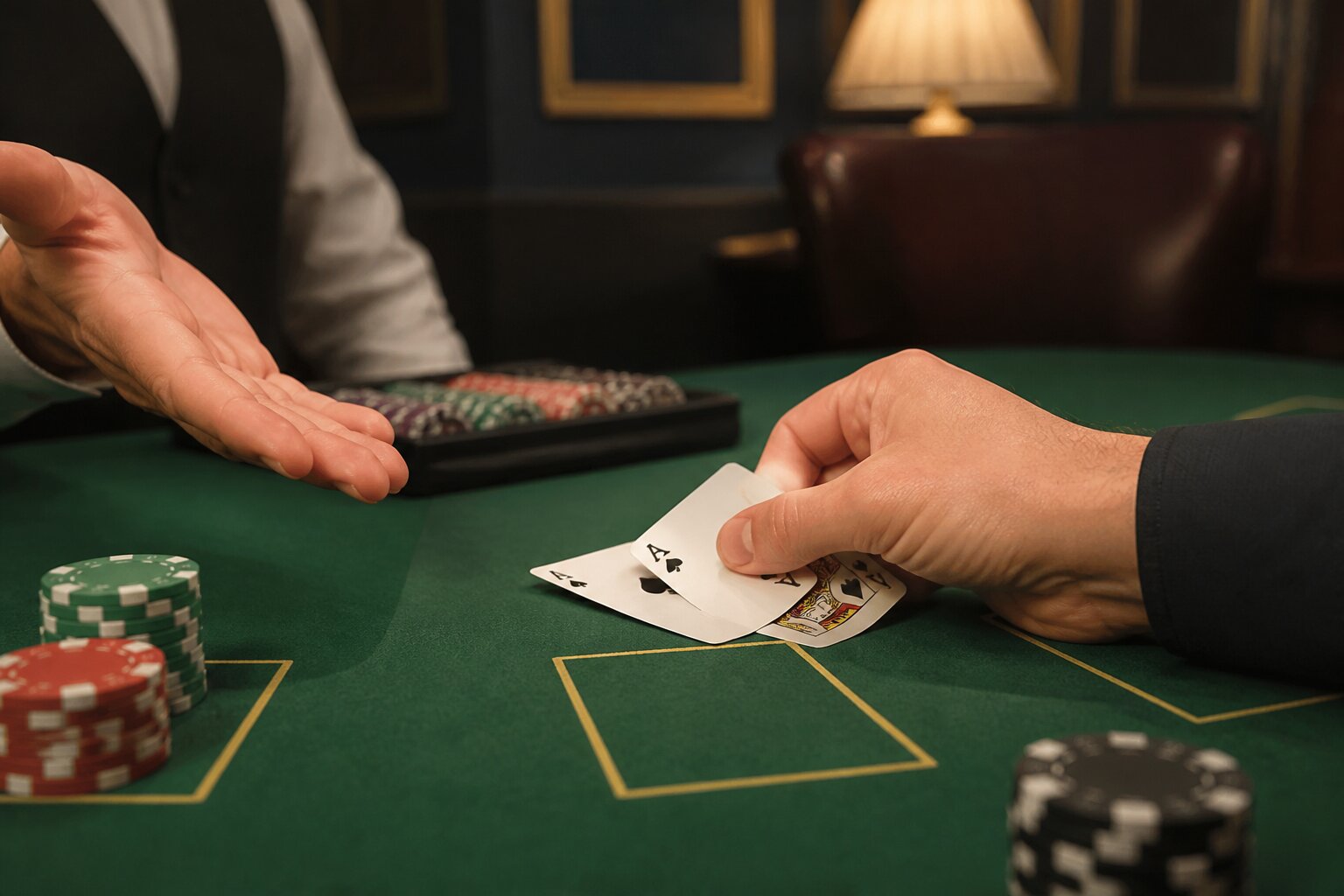
Imagine you’re playing blackjack and receive an ace and a picture card. The dealer pauses and asks: “Even money?” Those chips look tempting, but what does the offer actually mean and when is it sensible to accept?
This article explains what even money is, how it works at the table, the maths behind it, common misconceptions and when experienced players might take it. Read on to learn how the choice affects your payouts and to help you make a confident decision next time the dealer asks.
What Is Even Money in Blackjack?
Even money is a single option that appears only when you have a natural blackjack and the dealer’s face-up card is an ace. Rather than waiting to see whether the dealer also has blackjack, the dealer offers to pay you immediately at 1:1 on your stake.
Normally a player blackjack pays 3:2. If the dealer also has blackjack, the hand results in a push and no extra winnings are paid. Accepting even money avoids that push by guaranteeing a one-to-one payout instead of the higher 3:2 return. This option is mathematically identical to taking insurance on your blackjack, though it is presented as a direct offer.
Even money is about exchanging a higher possible payout for certainty. The next section describes exactly how that exchange plays out at the live table.
How Does Even Money Work at the Table?
When you hold blackjack and the dealer shows an ace, the dealer will offer even money before checking their hole card. If you accept, they immediately pay you 1:1 on your original bet and the hand is settled for you at that amount.
If you decline, the dealer will check for blackjack. If the dealer does not have blackjack, you receive the standard 3:2 payout for your blackjack. If they do, the hand is a push and your original stake is returned with no winnings.
This choice is made before the dealer completes the check, so it is essentially an early settlement. Later sections look at how that settlement compares with expected returns and how players commonly approach the decision.
Is Even Money the Same as Insurance?
Even money and insurance are closely related but offered in different circumstances and structured slightly differently. The dealer offers even money only when you already have a blackjack. Insurance is available to any player when the dealer shows an ace and is a separate side wager costing half the original stake. Insurance pays 2:1 if the dealer has blackjack.
When you accept even money it functions like taking full insurance on your blackjack: you receive a guaranteed 1:1 payout immediately. If you decline even money but take insurance instead, the insurance bet resolves separately and can offset a dealer blackjack while leaving your main hand to pay the usual 3:2 if the dealer does not have blackjack.
Both reduce short-term risk but do not improve the long-run expected return. The next section lays out the practical advantages and drawbacks of accepting even money.
Pros & Cons of Taking Even Money
Accepting even money has clear benefits and real costs. One benefit is certainty: a known payout removes the possibility of a push when the dealer also has blackjack. For players who prefer a stable outcome in that moment, the immediate 1:1 payout can be attractive. It also simplifies the decision process at a busy table.
The main disadvantages are the lower payout and the effect on expected value. By taking 1:1 instead of the standard 3:2, you forgo the higher return that most hands would deliver when the dealer does not have blackjack. Over many hands, this reduction in payout lowers average winnings compared with always declining even money. Accepting even money does not improve the underlying odds and therefore increases the relative house advantage when used regularly.
With those trade-offs in mind, the next section discusses which players might reasonably consider accepting even money and which typically decline it.
When Should You Consider Taking Even Money?
Whether to accept even money depends on personal goals, session length and tolerance for variance. Players aiming to maximise long-term returns tend to decline even money, because the higher payout usually outweighs the occasional push. Those who are playing briefly, prefer certainty, or are protecting a small bankroll may find taking even money sensible for that session.
If you value a predictable outcome in a short session or the payout helps you meet a pre-set goal, even money can be appropriate. Choosing it can reduce stress and simplify decision making, especially if you do not plan to play many more hands. If you prioritise the best mathematical expectation over many hands, declining is generally the stronger choice. The next section explains the numerical reasoning behind that conclusion.
Benefits for Casual Players
Casual players benefit from the simplicity and immediate settlement that even money offers. It removes the uncertainty of a push and can make the hand feel more decisive without requiring extra decisions.
For those playing socially or with limited time, the instant resolution can preserve enjoyment and keep play moving. The option can also help players stick to a pre-determined plan by converting a conditional outcome into a guaranteed result.
Scenarios Where Even Money Does Not Make Sense
Even money is less sensible when striving to maximise return. Statistically, the dealer will not have blackjack more often than they will, so refusing even money typically results in a higher average payout. For players comfortable with occasional pushes, declining will usually produce better results over time.
It is also unhelpful for disciplined players who follow basic strategy and are focused on long-term variance and expected value. In those cases, accepting even money reduces the already modest edge that correct play seeks to preserve.
Mathematics Behind Even Money
The decision comes down to expected value and the probability that the dealer’s hole card completes a blackjack. When the dealer shows an ace, the chance they have a ten-value card underneath is less than one in three. This means that more often than not, refusing even money leads to the higher 3:2 payout.
If you accept even money every time, you receive a guaranteed 1:1 and lose the extra 0.5 units you would earn on those occasions when the dealer does not have blackjack. Over many occurrences, that foregone amount accumulates and reduces your average return. Casinos present even money because it transfers some of the variance to the player while securing a predictable, slightly less favourable expected outcome for the casino.
Understanding those probabilities helps explain why mathematically minded players usually decline, while others choose certainty. The following section addresses common misunderstandings that influence decisions at the table.
Common Misconceptions About Even Money
One widespread misconception is that accepting even money improves a player’s odds of coming out ahead. In reality, it swaps a higher expected payout for certainty without changing the underlying probabilities. Another mistake is to treat even money as a protective strategy that increases long-term winnings; over repeated play it typically reduces average returns.
Some players assume that skilled tactics will make even money profitable. While skill affects many blackjack decisions, even money is a straight payout trade-off and does not become advantageous through strategy alone. Clear awareness of these points helps players make choices that fit their aims rather than reacting to mistaken beliefs. Next, we cover what experienced players tend to do and why.
Do Experienced Players Recommend Even Money?
Experienced players who focus on expected value will usually decline even money because it reduces average winnings over time. They accept the occasional push in exchange for the more favourable long-run return of the 3:2 payout.
That said, experienced players sometimes accept even money for non-mathematical reasons. In short sessions, when a certain payout aligns with session goals, or when a player prefers to lock in winnings for psychological or bankroll-management reasons, accepting even money can be reasonable. The common thread among experienced players is to make that choice deliberately, with awareness of the trade-off it represents.
With those perspectives in mind, the closing section summarises how to weigh the option when it arises.
Final Thoughts: Should You Take Even Money in Blackjack?
Taking even money is a personal decision that balances certainty against expected return. If your priority is maximising average winnings across many hands, declining even money is generally the better option. If you value an immediate, known payout—particularly in a short session or to protect a small stake—accepting even money can be sensible for that moment.
Make the choice that fits your aims and limits, and avoid relying on repeated use of even money as a strategy to increase returns. Keep wagers within what you can afford and view blackjack as entertainment, not a source of income. If gambling becomes difficult to control, support is available from organisations such as GamCare and BeGambleAware.
Whichever route you choose at the table, deciding with clarity will help you enjoy the game and manage your bankroll effectively.
**The information provided in this blog is intended for educational purposes and should not be construed as betting advice or a guarantee of success. Always gamble responsibly.