
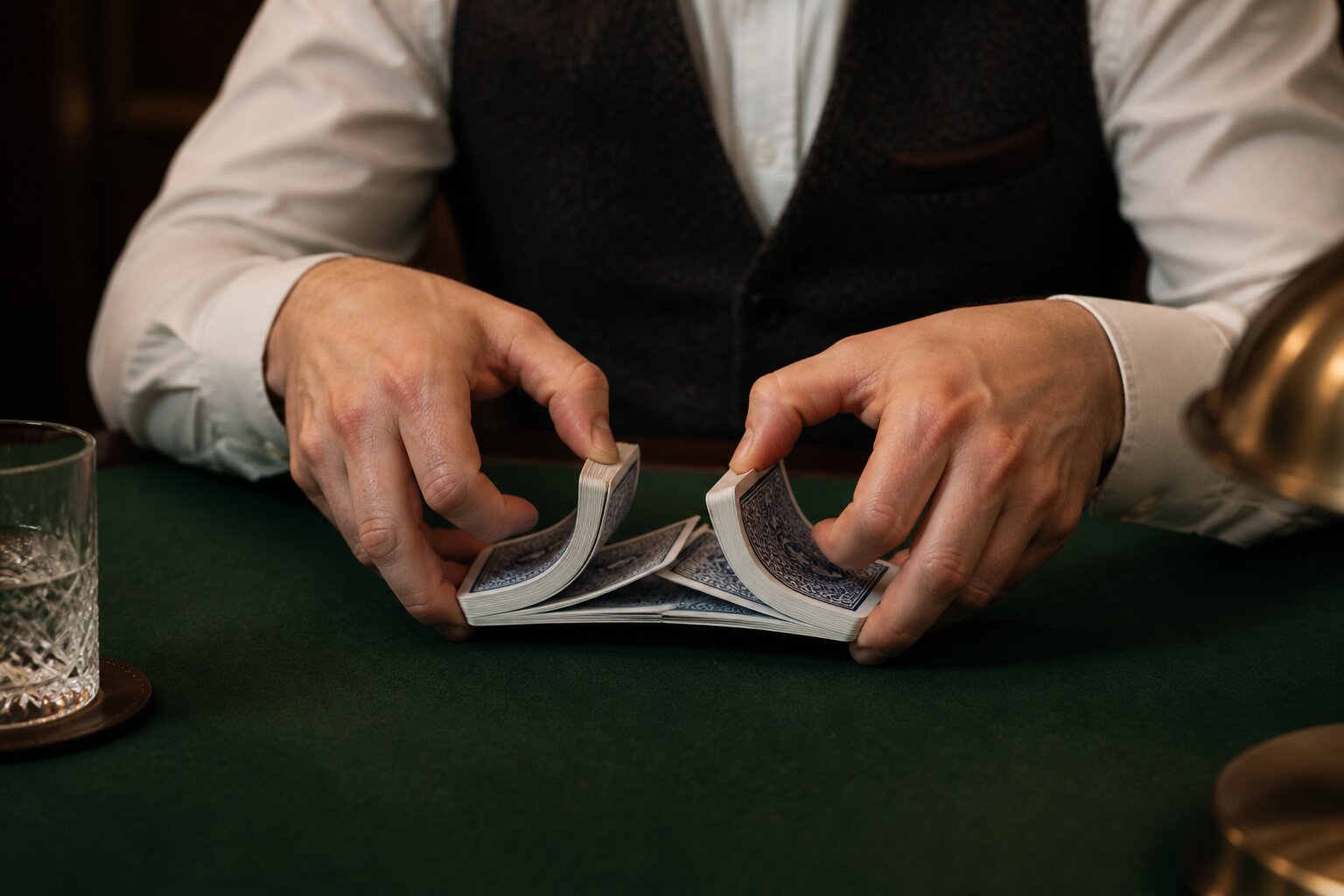
Ever picked up a deck of cards for a friendly game, only to fumble the shuffle and watch a carefully stacked pile tumble everywhere? There’s a certain satisfaction in shuffling cards smoothly, but it’s surprisingly easy to get it wrong. Maybe the cards stick together, clump awkwardly, or your poker face disappears when someone points out you’re shuffling like a beginner.
Card games are a staple of British get-togethers, from low-stakes nights around the kitchen table to the buzz of a local charity tournament. Yet shuffling remains a skill most of us learn by simply copying what we see, picking up mistakes as easily as creased court cards.
A proper shuffle does more than look neat; it ensures everyone gets a fair chance and keeps the game honest. Before trying fancy flourishes or half-remembered moves, it helps to know the common errors and how to avoid them so the deck stays in good order.
Why Proper Card Shuffling Matters
Shuffling correctly matters because it prevents predictable patterns and clumps of cards that can skew a game. When runs of cards remain together, one player may gain an advantage simply from the way the pack was handled. That undermines the sense of fair play and can sour even a friendly session.
Good shuffling also protects the reputation of any organised play. Venues and tournaments operate under strict standards, and careless handling that produces repeatable orders or damaged cards can reflect poorly on organisers and players alike.
Knowing why shuffling matters sets the scene for spotting common mistakes and learning techniques that actually mix the deck without harming it. Next, we’ll look at the most frequent errors people make when they shuffle.
Common Card Shuffling Mistakes
One of the most frequent mistakes is failing to mix the whole deck. People often shuffle only part of the pack or simply merge clumps rather than thoroughly interleaving every card. This leaves sequences from the previous deal intact, making outcomes easier to anticipate.
Gripping cards too hard is another common problem. Bending or twisting the pack, especially when attempting a dramatic riffle, creases corners and wears the card faces. Over time these marks make some cards identifiable and introduce an unintended bias.
Shuffling too few times is also an issue. A couple of quick cuts or a single overhand shuffle rarely produce genuine variety. Relying on one technique over and over, such as always using the same overhand rhythm, leaves parts of the deck untouched and reduces randomness.
Finally, forcing a shuffle in pursuit of a flashy result can create damage rather than a better mix. Cheap or thin decks suffer fastest, but even higher-quality cards show wear if handled roughly. Recognising these problems helps explain why gentler, more varied methods work better, which is what the next section explores.
Why Do Cards Get Damaged When Shuffling?
Cards suffer most when they are bent, twisted or pressed too firmly. Forcing a bridge or snapping cards sharply causes creases and frayed edges. Over time these defects become visible and can allow observant players to pick out specific cards, which undermines fairness. Using a light touch and appropriate techniques keeps a deck tidy for longer.
Are There Myths About 'Perfect' Shuffles?
A widely held belief is that a flawless, mechanical shuffle is always best. In reality, certain precise shuffles, such as an exact alternate interleave, can produce predictable cycles rather than true variety. Another myth is that only experts can shuffle well; most effective methods are learnable with a little practice and attention to gentle handling. What counts is achieving a consistent, well-mixed deck rather than a theatrical display.
Techniques for Shuffling Cards Correctly
The goal of any shuffle is a thorough mix without harm to the cards. The most reliable methods are the riffle shuffle, the overhand shuffle and the Hindu shuffle. Each gives a fair result when applied properly and repeated as needed, and switching between techniques often achieves the best balance of mixing and care for the pack.
A proper riffle involves splitting the deck, interleaving the cards gently and squaring the stack again. The overhand shuffle redistributes small packets from the top of the pack into your palm. The Hindu shuffle is a single-hand motion that slides packets off the top into the other hand. All three produce good mixing when done repeatedly and without force.
These methods also differ in how they wear cards and how easy they are to learn, which is useful when choosing which to use at a family night or a more formal game. The next sections explain each technique in depth, starting with the overhand shuffle and then showing how a riffle is performed and where it best fits into play.
Overhand Shuffle Explained
The overhand shuffle is a straightforward method favoured at many British tables. It suits smaller hands and newer players because it demands little grip strength and avoids bending the deck sharply. To perform it, hold the pack in one hand and use the other to pull off small groups from the top, letting them fall into a loose pile. Repeating this several times spreads cards through the stack.
It takes multiple repetitions to reduce patterns significantly, and the exact number depends on how thoroughly packets are transferred each time. Rather than chasing a fixed count, focus on how well each pass changes the order. Practising a relaxed rhythm and varying the packet sizes improves the shuffle without introducing wear.
Used on its own the overhand shuffle works well for casual play and keeps cards in good condition, but combining it with other techniques can give a more complete mix for games that need it. That leads naturally into the riffle shuffle, which often produces a more even interleaving in fewer repetitions.
The Riffle Shuffle: How It Works
The riffle shuffle is one of the most familiar shuffling methods and is often chosen when a thorough mix is needed. When carried out gently it interleaves cards from two halves of the deck to create a consistent spread.
How to Do a Riffle Shuffle
Split the deck roughly in half and hold each half between the thumb and fingers of each hand.
Place the halves close together, with a small gap and the shorter sides resting on a flat surface for stability.
Use your thumbs to release the cards so they fall together in an interlaced pattern; the aim is a loose alternation rather than perfect placement.
Push the two halves together and square the deck so it forms a neat stack again.
An optional bridge can bend the deck slightly so the cards settle into place, but this should be done gently to avoid bending or creasing.
When to Use a Riffle Shuffle
Riffle shuffles are effective for poker-sized decks and for games where a solid mix is important. They typically achieve a good level of randomness in fewer repetitions than an overhand shuffle, which is why they are preferred in more formal settings. Riffles require a bit more practice to perform smoothly without damage, so they work best with firmer cards and a flat playing surface.
Comparison with Other Techniques
Compared with the overhand shuffle, the riffle tends to mix the deck more thoroughly per pass, but it can stress cards if handled roughly. The overhand method is gentler and easier for beginners, while the Hindu shuffle offers a quick single-handed alternative. Alternating between two or more techniques produces a well-balanced shuffle without accelerating wear, which is why many experienced players mix their approach.
When Should You Use Each Shuffling Method?
Choosing a method depends on the setting, the type of deck and who is playing. For relaxed family games or when children are involved, the overhand shuffle is user-friendly and gentle on the cards. For tournaments or games that demand a firmer mix, riffle shuffles are appropriate once the person shuffling is comfortable with the motion.
When using new or thin cards, combining gentle overhand passes with occasional riffles gives a good compromise between protection and thorough mixing. Changing techniques also prevents repeatable patterns from forming, so rotating between methods during longer sessions helps maintain fairness.
Practical examples help illustrate how choice matters. At a friendly rummy evening, a few overhand shuffles between deals will usually be sufficient and keep the deck neat. In contrast, a home poker game with higher stakes benefits from a couple of careful riffle shuffles supplemented by an overhand pass to break any residual sequences. The following section gives a clear sequence for the overhand shuffle that many players find useful to practise.
How to Perform the Overhand Shuffle
Hold the deck in the non-dominant hand, thumb at one edge and fingers at the other.
Use the dominant hand to grip the top of the deck with the thumb and fingers.
Slide off a small packet of cards with the dominant thumb, allowing them to drop into the palm.
Continue sliding off small groups until all cards have transferred into the palm.
Pick up the newly shuffled stack and repeat several times for best results.
A practical tip is to vary the packet sizes and keep the motion relaxed; steady repetition is what builds a reliable shuffle rather than speed or force. With a few practice passes the overhand shuffle becomes both quick and effective without straining the cards.
Maintaining Your Playing Cards
Taking care of playing cards prolongs their usefulness and keeps games running smoothly. Clean hands before a session to reduce oils and dirt that cause sticking and marks. If a long session is expected, short breaks help prevent sweat from affecting the pack.
Store cards in a case or their original box to protect them from dust, spills and humidity. Avoid leaving decks in direct sunlight or damp places as this can warp and fade the cards. Rotating between two or three decks spreads wear and keeps any single pack from showing telltale signs.
Play on a clean, flat surface to reduce scratches and bent corners. Replace a deck when cards begin to stick, show creases or develop marks that let some cards be distinguished. Little precautions when shuffling and storing keep your decks ready for game night and ensure everyone enjoys fair play.
A final word: gentle handling, a mix of proven techniques and regular maintenance mean shuffles look smooth, cards last longer and the game stays fair for everyone involved.
Play Online Casino Games at Pay By Mobile Casino
At Pay By Mobile Casino, we love to welcome new players who are looking to enjoy our selection of online games in a relaxed atmosphere. If you are in the mood for some entertainment, we would be delighted to have you join us.
Getting started with us is simple: just create your account, deposit and you can start exploring what we have to offer. We look forward to having you with us and hope you have a great time.
**The information provided in this blog is intended for educational purposes and should not be construed as betting advice or a guarantee of success. Always gamble responsibly.