
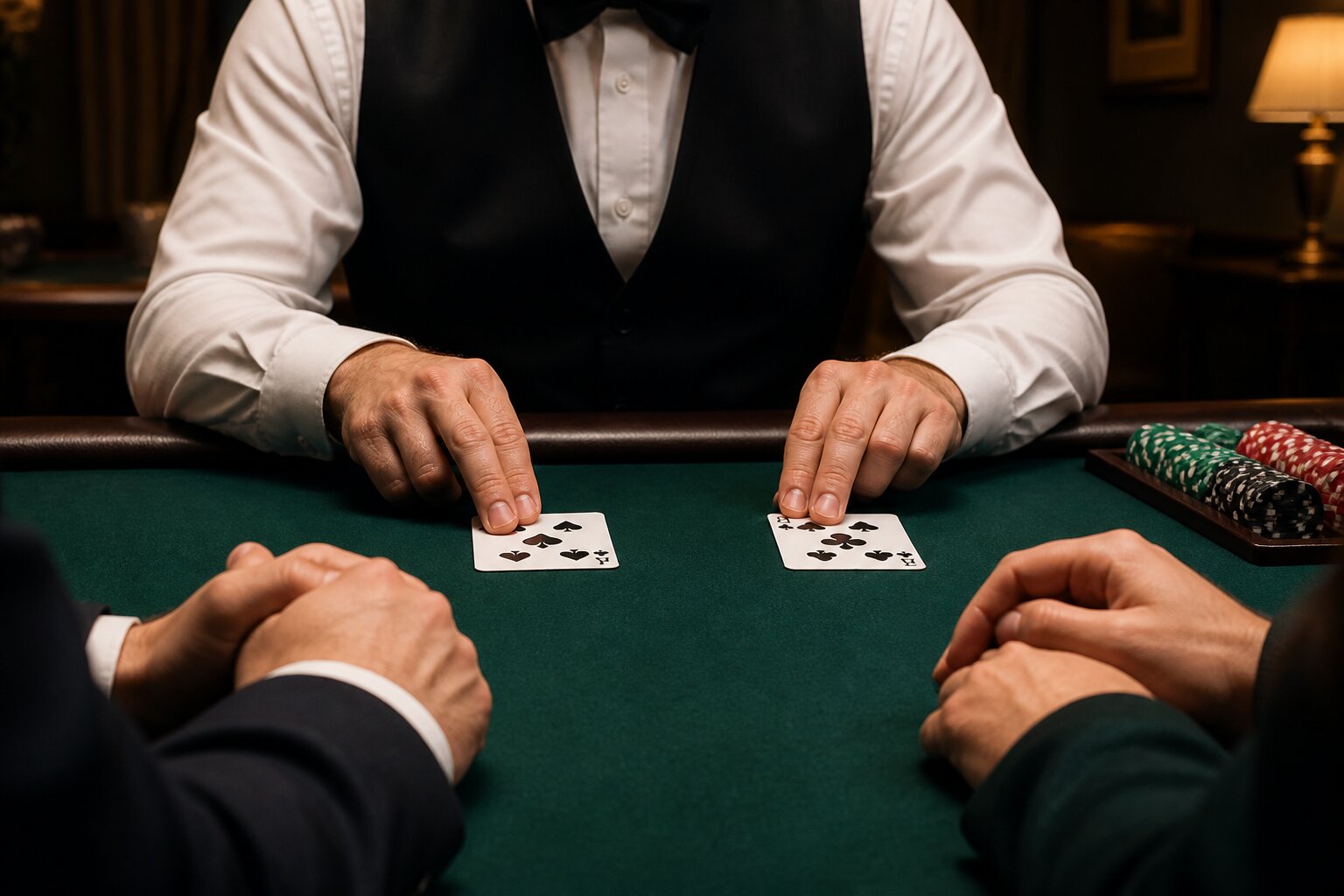
Blackjack is a staple at UK casinos, both in person and online, but the jargon can trip up newcomers. One of the most common terms you will hear at the table is “push,” and knowing exactly what that means makes the game easier to follow.
This article explains push, tie and related terms clearly, shows how pushes are handled at the table, and clears up common misunderstandings so you can play with confidence.
What Is a Push in Blackjack?
A push happens when the player’s final hand total equals the dealer’s final hand total at the end of a round. When that occurs, neither side wins and the player’s bet is returned. The result is neutral: the stake goes back to the player and play moves on to the next hand.
A push is not a loss, nor is it a payout. It’s simply the game arriving at an even result after all cards have been dealt and actions completed. Understanding this will help you interpret what happens to your chips when the dealer announces a push, and it sets the scene for how pushes come about in play.
How Does a Push Occur in a Game?
A push arises once both sides have finished taking cards and the totals match. This can happen in several common ways: both player and dealer stand on the same number, both reach the same total after hits, or both are dealt blackjack from the start.
The outcome is determined after any dealer drawing rules have been followed. The dealer’s actions are governed by the table rules, which decide whether they hit or stand on certain totals; once those are resolved, a matching total between dealer and player results in a push. Next, we’ll look at the language used around these outcomes and what each term means.
Push vs Tie: Is There a Difference?
In practice, “push” and “tie” mean the same thing in blackjack: equal hand totals that produce no win or loss. Casinos tend to favour the term “push,” but “tie” is simply another way of describing the same result. Both terms lead to the same handling of bets and the same effect on a player’s balance.
There is, however, a related term that is different in outcome: “even money.” That describes a situation where a player accepts a 1:1 payout for a blackjack when the dealer shows an ace. That payout is a win, not a returned stake, so it should not be confused with a push.
Common Terms Related to Pushes in Blackjack
Familiarity with a few related terms helps when following a round. Words like “draw,” “stand-off” and “even money” are often used in conversation about hands that do not produce a clear winner.
A draw or stand-off simply restates the idea of an equal result between player and dealer, with bets returned to the player. In practice these terms are interchangeable, and they describe the same outcome where neither side wins nor loses.
Even money, as noted above, is an option for being paid at 1:1 in a specific circumstance and is different from a push. It is offered in limited situations and involves accepting a straightforward win instead of risking a tied outcome on a higher payout option.
With those distinctions clear, the next section explains exactly what happens to bets when a push occurs.
What Happens to Bets During a Push?
When a push happens, the stake is returned to the player immediately. In a land-based game the dealer usually pushes the chips back across the table; in an online game the amount is credited back to the player’s balance automatically. No additional winnings are paid and no money is taken, so the player’s overall position remains unchanged for that hand.
House rules can vary in small ways, so it is sensible to check the table rules if anything about bet handling seems unusual. With the mechanics of bets set out, the next question many players ask is whether a push changes their chances of winning later on.
Does a Push Affect Your Chances of Winning?
A push has no bearing on future hands. Each round of blackjack is resolved independently, so a push neither improves nor worsens the odds for the next deal. It simply returns the stake and the game proceeds with a fresh outcome. The card values that caused the push are already removed from the deck for that shoe or hand, but that does not change the fundamental fact that the next round will be decided by newly dealt cards and the same probabilities apply.
This independence is part of why players focus on consistent decision-making rather than trying to react to previous results. Chasing a perceived lucky run or changing bets because of a push tends to introduce inconsistent behaviour that can increase losses over time. With that in mind, the following section addresses common misunderstandings players have about pushes, clarifying that a push is not a partial win, not an indicator of inevitable future wins, and not something that should automatically alter a sensible betting or playing strategy.
Can Players Prevent a Push?
There is no reliable method to prevent a push because it depends on the cards dealt and the standard rules for hitting and standing. Strategic choices influence expected returns overall, but they cannot eliminate the chance of a drawn outcome in any single hand.
Players are best served by understanding the rules, making decisions that fit their playing style, and accepting that pushes are one of the normal outcomes in the game. While sound strategy can reduce losses and improve long-term results, it cannot change the fact that some hands will simply finish level.
Some tables offer options such as surrender or insurance that can alter the way certain hands are resolved, but these do not guarantee avoidance of pushes and often come with their own costs or statistical consequences. Knowing how these options work helps players make informed choices and sets realistic expectations about what strategy can and cannot achieve.
Misconceptions About Pushes in Blackjack
A frequent error is to treat a push as a loss; in reality the stake is simply returned. Some players think many pushes indicate a problem with the game or dealer, but draws occur naturally under the rules and do not signal anything untoward.
Another misconception is that past pushes change the likelihood of future results. Because each hand is resolved independently, past outcomes do not alter the probabilities that govern later hands. Finally, there is a belief that special techniques can remove pushes from play; in truth no strategy can guarantee that result.
Clearing up these points helps set realistic expectations. To finish, we consider why understanding pushes matters for anyone who plays blackjack.
Understanding Why Pushes Matter to Players
Knowing what a push is and how it is handled keeps gameplay clear and avoids surprises when a hand ends evenly. Recognising that pushes are a normal outcome helps players manage expectations and make reasoned choices about bets and play style.
Being familiar with all possible outcomes, including pushes, supports safe and informed play and contributes to a fair experience at the table. With that understanding, players can focus on enjoying the game and making decisions that suit their strategies and bankroll.
**The information provided in this blog is intended for educational purposes and should not be construed as betting advice or a guarantee of success. Always gamble responsibly.