
Ever wondered how the simple challenge of beating the dealer by getting as close to 21 as possible became a staple at every casino? Whether you play a quick hand in a local card room or online, blackjack has a familiar feel that seems to belong everywhere.
Its beginnings are a little murky, with tales that lead us through French gambling salons and Spanish parlours. The game’s early forms reflect wider European card-playing traditions and centuries of small rule changes that gradually created the version most people recognise today.
Pull up a chair and let’s trace how that two-card 21 came to be, and how the game’s identity shifted as it spread.
The Earliest Origins of Blackjack
Blackjack’s story can be traced back to 17th-century Europe, where the French game “Vingt-et-Un” (twenty-one) is the closest known ancestor. Played in salons and gambling houses, Vingt-et-Un centred on reaching a total of 21 without going over, and it introduced early ideas such as a permanent banker and betting after cards were dealt. Those features helped shape the rhythm and competitive feel that later became central to blackjack.
Spain offered a related idea with “Trenta y Uno” (one and thirty), where players aimed for a total of 31 using three cards. Although the target and card-counting methods differed, the core tension—drawing cards to approach a set number while avoiding busting—was a shared principle that travelled between countries.
These games didn’t invent a single, fixed set of rules; instead they created overlapping practices that were adapted over time across Europe. From here, the game’s basic aim — reach a target without exceeding it — set the stage for later developments in both rules and play style. Read on to see how regional variations supplied specific elements that merged into the game we now call blackjack.
Influences from French and Spanish Card Games
France and Spain contributed distinct ingredients that blended into modern blackjack. From France came the direct target of 21 and the idea of a banker facing a table of challengers. Vingt-et-Un introduced flexible betting and variations in dealing that encouraged tactical choices about drawing and standing. Other French games added practical elements: whether cards were dealt face up or down, and how the bank changed hands in different sessions.
Spanish card games emphasised different numerical targets and approaches to card value. Trenta y Uno’s three-card limit and higher target encouraged a style of play focused on precise totals and selective draws. Some Spanish variants also experimented with special card values, demonstrating how cultural preferences shaped rule tweaks.
Taken together, these influences formed a toolkit of mechanics: target totals, banker-versus-players structure, and varied drawing rules. These mechanics moved between tables and countries, evolving further as the game crossed to the Americas and encountered new gambling cultures. The next section explains how one such cultural shift left its mark on the game’s name.
Why Is It Called Blackjack?
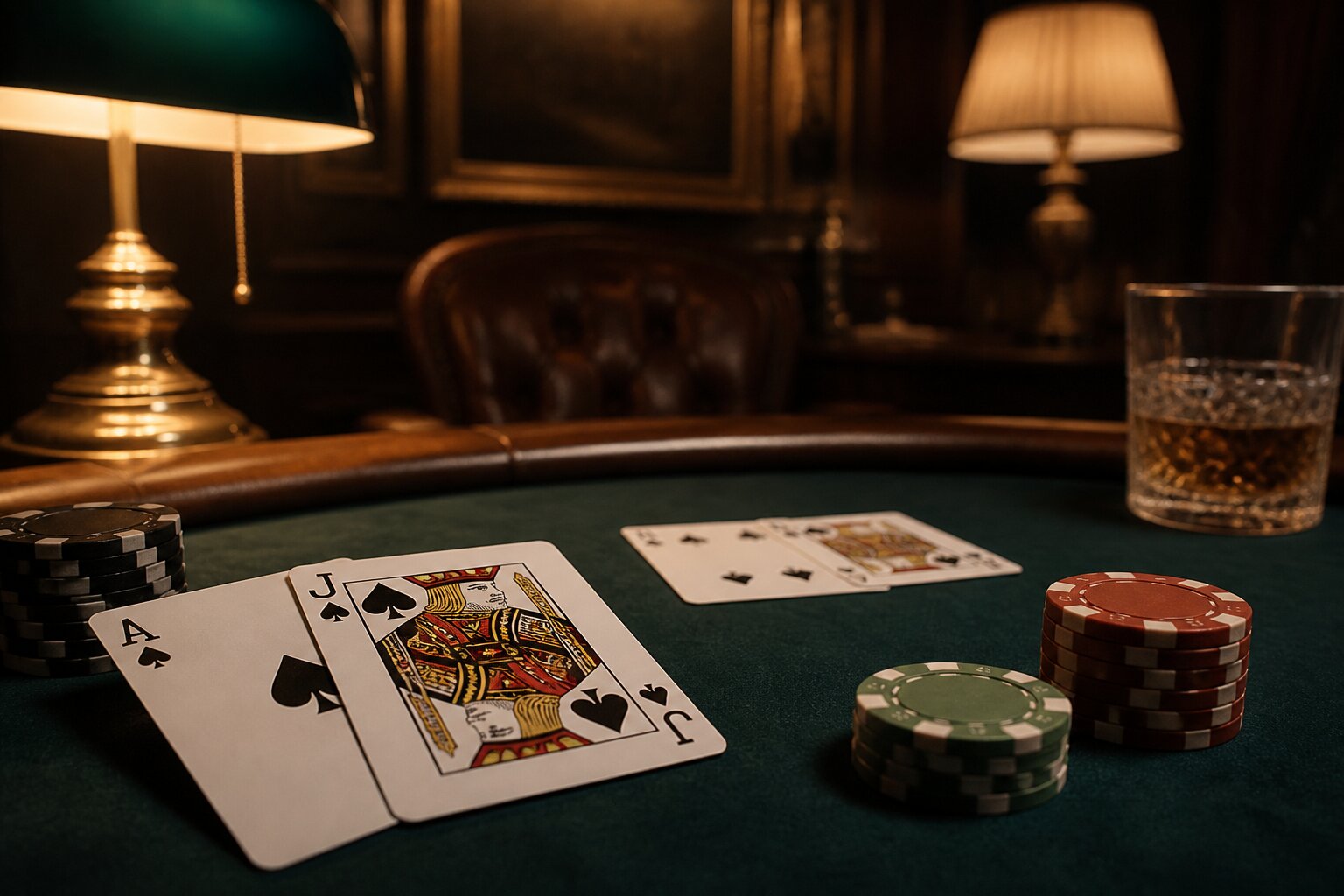
The modern name “blackjack” arrived after the game was already established as “twenty-one.” In North American gambling houses, promoters offered enhanced payouts to make the game more attractive. One such promotion rewarded a two-card 21 made with an ace plus a black jack (the jack of spades or clubs). That specific, high-paying combination became popularly known as a “blackjack.”
The bonus itself faded from common play, but the name remained and soon replaced “twenty-one” in everyday use. Today, “blackjack” refers both to the game and to any two-card 21 produced by an ace and a ten-value card, regardless of suits. The shift in terminology is a neat example of how promotional practices and player language can leave a lasting imprint on a game’s identity.
Next we’ll look at how casinos used promotions and structure to take blackjack from tables in private houses to centre stage on the gaming floor.
The Role of Casinos in Popularising the Game
Casinos turned blackjack into a public spectacle by standardising play and creating attractive tables for newcomers and regulars alike. Early house rules and promotional payouts helped the game stand out, while a consistent dealer-versus-players layout simplified play for larger audiences. As venues became more formalised, casinos established procedures—who acted as banker, how cards were dealt and paid, and what bets were allowed—that made games easier to learn and safer to run.
During the 20th century, Tournaments, celebrity players, and television broadcasts brought the game into mainstream awareness; players could see not only the cards but also the tactics and decision-making that make the game engaging. Later, electronic and online platforms further broadened access, offering many variants and live-dealer formats that replicate the in-room experience.
Casinos have continually adjusted rules and side bets to appeal to different audiences, but at the heart of these changes is a goal to balance clarity for players with a workable house structure. That balance has guided the game’s ongoing evolution, which the next section explores in more detail.
Next we’ll look at how casinos used promotions and structure to take blackjack from tables in private houses to centre stage on the gaming floor.
Blackjack’s Evolution Over Time
From the 18th-century salon to the 21st-century app, blackjack has kept its central aim while adapting around rule and format changes. By the 1800s the basic framework had crossed borders and stabilised into a recognisable fifty-fifty contest between player choices and dealer constraints. In the 20th century, mathematical analysis reshaped player strategy: work on probabilities led to basic strategy charts that reduce the game’s uncertainty and inform optimal choices.
Variants emerged that altered deck composition, dealer rules, or payout structures. Games such as Pontoon and Spanish 21 introduced different card valuations and bonus pays, showing how small adjustments produce distinct play experiences. The arrival of online play added multi-hand options, side bets, and live-streamed dealer tables, expanding how people engage with the game while preserving the familiar objective of beating the dealer without exceeding 21.
This continuous adaptation means that while the underlying idea is centuries old, the ways people play can vary widely. The next section looks at common myths that people still repeat about the game’s origins.
Famous Myths About Blackjack’s Origins
Several persistent myths cloud blackjack’s history, but examining evidence clears them up. One myth claims a single inventor created blackjack; in fact the game formed gradually from multiple regional variants. Another assumes blackjack was invented in formal casinos; historical records show household and salon play predates many institutional settings. The belief that the game was always called “blackjack” overlooks the later, promotional origin of the name discussed earlier. Finally, the notion that rules have remained unchanged is inaccurate—rules, payouts and formats have shifted repeatedly as the game spread and adapted.
Recognising these misconceptions helps appreciate blackjack as a product of cultural exchange and incremental change rather than a single moment of invention. Understanding that process brings us back to the game’s present form and explains why so many variants now exist.
Blackjack’s journey from French and Spanish parlours to modern tables shows a long history of small adaptations, each shaping how players approach the game today.
Play Online Casino Games at Pay By Mobile Casino
At Pay By Mobile Casino, we invite you to relax and enjoy the entertainment our site has to offer. Spend some time with us and discover an easy-going way to play online casino games for fun.
It’s all straightforward: just create your account, make a deposit and you’re ready to start exploring. We’re here to make your experience easy and enjoyable every step of the way.
**The information provided in this blog is intended for educational purposes and should not be construed as betting advice or a guarantee of success. Always gamble responsibly.